
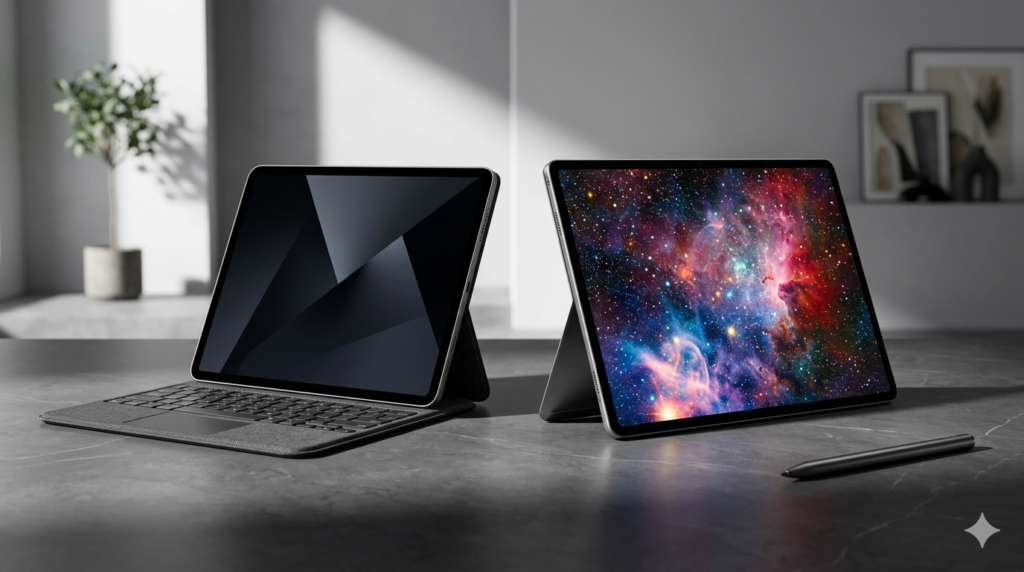
iPad Pro M5 vs Galaxy Tab S11 | Which premium path actually fits your routine
A premium tablet comparison is only useful when the buyer is honest about why they are spending flagship money. One side is Apple’s highest tablet ceiling. The other is Samsung’s flagship Android experience. Both are strong, but they justify premium in different ways.
Why these two flagships only overlap for certain buyers
These two overlap when the buyer has already accepted flagship pricing and now wants to know what kind of flagship experience actually makes sense. iPad Pro M5 appeals to buyers who want the best iPad available, with Apple ecosystem depth and very high long-term confidence. Galaxy Tab S11 appeals to buyers who want a premium Android tablet that feels clearly flagship in screen quality, Samsung familiarity, and everyday media richness.
That makes this a comparison between two different definitions of premium. One side says premium means the most complete Apple tablet experience. The other says premium means a top-tier Android tablet that feels luxurious and capable without asking the buyer to enter Apple’s world. The better choice depends on which version of premium the buyer will feel most often.
Premium does not mean the same thing on both sides
On the iPad Pro side, premium often means depth: display quality, hardware confidence, ecosystem integration, accessory polish, and a sense that the device will still feel serious years later. It is the tablet for buyers who do not want to wonder whether they should have gone higher, because there is no higher Apple tablet to go to.
On the Galaxy Tab S11 side, premium often feels more immediate. Buyers notice the screen character, the Samsung polish, the bundled value logic, and the familiarity of an Android flagship that does not try to imitate Apple. It is a different kind of satisfaction: less about owning the top iPad, more about owning the Android flagship that feels complete and rewarding in daily use.
Display class and hardware floor are part of the real split
At this level, buyers are allowed to care about the finer parts of the experience. Display class, motion feel, storage floor, and overall hardware confidence are not minor details when the price is already premium. They are part of the reason to spend this much in the first place, especially for buyers who use the tablet often and notice quality every day.
But even here, the better hardware story is not universal. Some buyers will value Apple’s top-tier iPad feel more because it lives inside a wider Apple workflow. Others will value the Galaxy Tab’s flagship Android experience more because it feels more coherent with their phone, media habits, and Samsung comfort. Premium only matters if the buyer keeps feeling it after the purchase.
Ports, storage, and expansion shape long-term value
Long-term value at this price is rarely about one benchmark. It is about how complete and flexible the device feels once the buyer starts using it seriously. Storage expectations, external display use, file movement, peripherals, and upgrade pressure all shape whether the price feels justified over time.
That is why some buyers can rationally choose the iPad Pro even at a higher cost, while others can rationally prefer Galaxy Tab S11 without feeling like they settled. Each product is selling a different long-term logic. One is Apple’s highest tablet ceiling. The other is a premium Android flagship with a value structure that can feel more practical inside that ecosystem.
Which kind of buyer can justify each premium
iPad Pro M5 is easiest to justify for buyers who already know they want the very best iPad and who expect the tablet to be a serious long-term device inside an Apple-heavy setup. It fits people who care about screen quality, hardware confidence, accessories, multitasking, and not wondering later whether they should have gone all the way to the top.
Galaxy Tab S11 is easier to justify for buyers who want a premium tablet experience but want that premium to feel rooted in Samsung and Android, not borrowed from Apple logic. It fits people who value a flagship display, Samsung familiarity, and a package that feels luxurious without requiring them to rebuild their workflow around Apple’s ecosystem.
Who should stop forcing this matchup
Skip iPad Pro M5 if the buyer likes the idea of “best iPad” more than the reality of paying flagship money for a tablet whose deeper strengths may go underused. In that case, the product can remain impressive while still being more tablet than the buyer meaningfully needs.
Skip Galaxy Tab S11 if the buyer is already deeply committed to Apple devices and expects the tablet to share work, files, accessories, and routines with them all the time. Then the Tab’s flagship Android strengths may remain real, but they may not solve the buyer’s most repeated daily needs as cleanly as the iPad Pro would.
The cleanest way to break the tie
Do not ask which one is more premium in the abstract. Ask which premium story you are actually paying for. Are you paying for the top iPad that can sit at the center of an Apple workflow for years, or for the Android flagship that feels rich and satisfying inside a Samsung-centered life?
That framing helps because it turns the choice away from generic luxury and toward lived ownership. Once the buyer knows which form of premium will be noticed most often, the rest of the comparison becomes much less confusing.
Which kind of flagship premium you actually want to pay for
iPad Pro M5 is the right flagship for buyers who want the highest Apple tablet ceiling and expect to use that ceiling often enough to justify it. Galaxy Tab S11 is the right flagship for buyers who want a premium Android tablet that feels complete, luxurious, and natural inside a Samsung-centered routine.
The winner is not the device with the louder spec story. It is the device whose version of premium still feels right after the buyer stops admiring it and starts relying on it.
Where buyers misread the flagship question
Buyers often assume that flagship versus flagship means the strengths should be measured on the same scale. That is not quite true here. One product is strongest when it is the crown jewel of an Apple workflow. The other is strongest when it becomes the premium Android tablet that makes sense without apology inside a Samsung-based setup.
The second mistake is letting price alone decide which premium feels “responsible.” High price can still be rational if the buyer uses the product deeply. Lower relative cost can still be the weaker choice if it creates more daily friction. Premium buying only makes sense when the ownership logic is as strong as the hardware logic.
The right flagship is the one whose premium you will keep noticing
Think about your next two years, not your next two hours. Which tablet will still feel more coherent with your notes, files, accessories, and other devices after the excitement of a new purchase disappears?
Both are expensive enough that buyer intent matters more than specs alone. iPad Pro M5 wins when Apple’s highest-end tablet fit is already clear. Galaxy Tab S11 wins when premium Android ownership is the real goal, not just an alternative to Apple.
Related comparisons and guides