
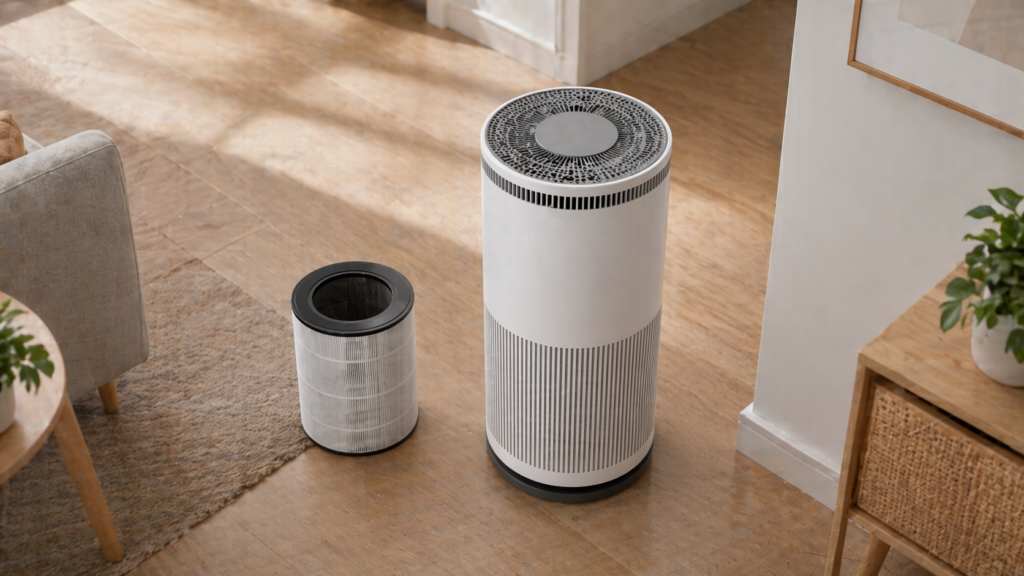
Air Purifier Filter Cost Guide
Filter cost is where many purifier purchases become more honest. A model can look cheap, premium, or well balanced at checkout, but the longer you own it, the more its real personality is shaped by replacement intervals, electricity use, and whether you feel comfortable paying for its upkeep year after year.
That is why this guide is not really about filters in isolation. It is about total ownership behavior. The Coway Mighty keeps earning respect because it stays affordable to own. The Levoit Core 400S and Core 600S look better once you connect their filter cost to what they deliver in room coverage. Blueair appeals partly because its energy use stays light. The Dyson BP03 only becomes reasonable if its premium air-quality angle matters enough to justify the overall spend.
Why the sticker price often hides the real cost of ownership
Air purifiers are easy to underestimate because the hardware purchase feels like the big decision. In reality, the longer-term cost of keeping the machine useful often matters more. Replacement filters are not optional if you want the purifier to keep behaving like the product you originally bought. That changes the meaning of “value” more than many buyers expect.
A low purchase price can still be a strong value, but only if the ongoing cost stays reasonable. A premium model can still make sense, but only if its long-term ownership burden matches what it actually adds to daily life. Cost is not just math here. It is also tolerance.
Coway still feels cheap in the best way
The Coway AP-1512HH Mighty remains one of the clearest examples of good low-cost ownership. Its filter set is not free, but the overall structure stays manageable enough that the machine does not punish you later for buying it early. That is a major reason it has stayed relevant for so long.
This makes Coway attractive not only for entry-level buyers, but also for cautious buyers who hate the feeling of falling into an expensive upkeep cycle. The machine does not just start affordable. It stays understandable.
Levoit 400S is not cheap to own, but its value still makes sense
The Levoit Core 400S asks for more ongoing filter spending than Coway, and that matters. It is not the kind of purifier you buy purely because it is inexpensive to maintain. What saves it is that the ownership cost still feels tied to a product many buyers actively want to live with. You are paying for a modern mid-size purifier with useful app control, strong pet-household reputation, and a more contemporary ownership experience.
In other words, the Core 400S works when the buyer is not chasing the cheapest lifecycle. It works when the buyer wants a more satisfying middle ground and is willing to pay for that balance.
Core 600S becomes easier to justify once coverage enters the cost equation
If you look at the Core 600S only through annual filter cost, it can feel noticeably heavier than smaller mainstream choices. If you look at it as a large-room purifier with strong practical coverage for the money, the story changes. It is more expensive to maintain than the 400S, but it also replaces the need to stretch a smaller purifier beyond its comfort zone.
That is why ownership cost should never be read without room size. Expensive upkeep on the wrong purifier is wasteful. Reasonable upkeep on the right size class can still be good value.
Blueair wins some buyers by making electricity feel almost irrelevant
Blueair’s appeal is not only about filters. It is also about power use. When a purifier is quiet and efficient enough that running it all day does not feel like a financial annoyance, it starts to feel easier to trust and easier to keep on. That low-friction ownership experience matters more than many buyers realize at first.
Blueair is not automatically the cheapest answer, but it often feels lighter to own than buyers expect. That matters most for people who are planning to run a purifier continuously rather than occasionally.
Dyson only works if the premium problem is real enough
The Dyson BP03 is the hardest model in this group to justify through cost alone. It is expensive to buy, and buyers can easily talk themselves into it for the wrong reasons. The ownership case only starts to hold together when its large-space coverage, formaldehyde focus, and unusually long HEPA interval align with the actual problem in the home.
That means Dyson is not really a “good value” purifier in the normal sense. It is a rational purchase only when the buyer has premium needs that cheaper purifiers do not address in the same way. Without that, the cost starts to feel ornamental rather than necessary.
The cheapest purifier is not always the least expensive decision
Buyers often use “cheap” to mean both low purchase price and low total cost, but those are not the same thing. A purifier that feels inexpensive upfront can become frustrating if the filters are frequent, the room fit is weak, or the machine ends up underpowered for the job. That kind of purchase often costs more emotionally than it does financially.
The better question is not “which purifier costs the least?” but “which purifier will still feel reasonable after a year of use?” That is a much more useful ownership test.
Who should optimize for ownership cost first
Buyers who plan to run a purifier constantly, buyers on tighter budgets, and buyers who already know they dislike expensive upkeep should put filter cost near the top of the decision tree. For them, Coway often looks strongest, and Blueair can be more attractive than expected because of its efficiency. Levoit can still make sense, but usually because room fit and feature set justify the extra cost.
Buyers who care most about one premium air-quality problem, like formaldehyde, or who need unusually large coverage may reasonably accept a heavier cost structure. The key is making sure the premium is solving a real discomfort rather than just offering a shinier product story.
What cost-aware buyers should ask before choosing
Before buying, ask whether the purifier’s ongoing cost still feels fair for the room size and air-quality problem you are trying to solve. Then ask whether you are paying to remove a real annoyance from your life or paying for features that simply sound premium in theory.
That is the most useful way to think about filter cost. Ownership is not only about what you spend. It is about whether the purifier keeps feeling worth it after the excitement of buying it wears off.
What to read before you decide
![무선이어폰 예산별 추천 [2026] — 2만 원대부터 35만 원대까지](https://pyjdeals.com/wp-content/uploads/2026/03/earbuds-04-post-7813-7813-1024x682.jpg)