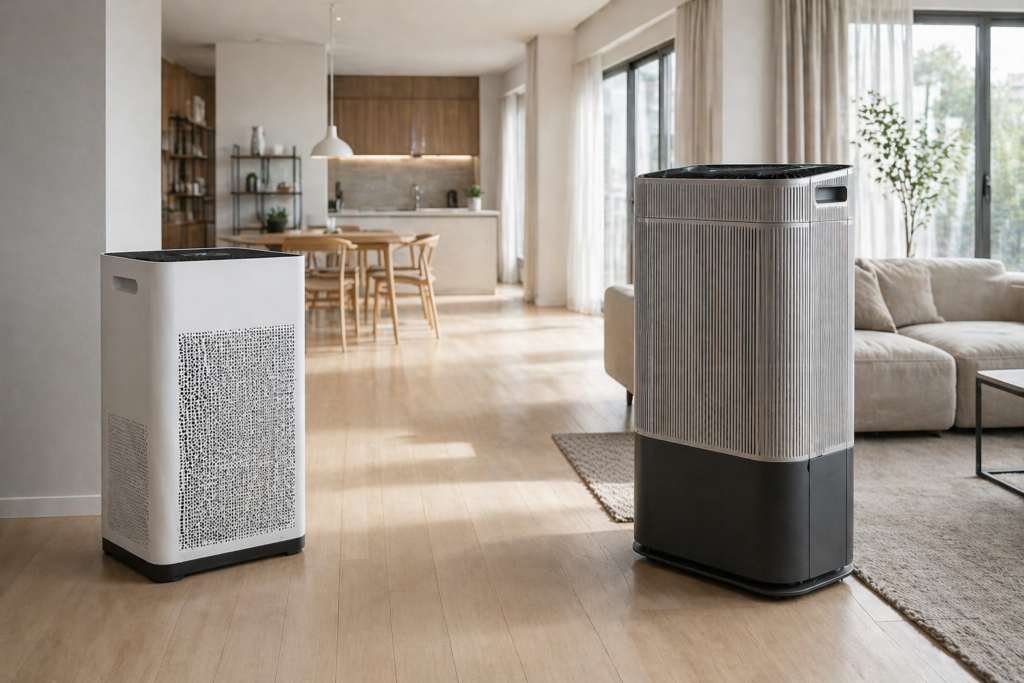
Blueair 311i Max vs Dyson BP03
This comparison looks dramatic in price, but the real divide is not simply budget. It is whether your problem is still normal enough for Blueair or specific enough to justify Dyson. It is whether you want a refined large-room purifier that stays relatively grounded, or a premium specialist machine built around formaldehyde concern and high-end sensor visibility. Blueair and Dyson are both premium-leaning in different ways, but they justify themselves very differently.
This is not a simple “save money or spend more” decision. It is a decision about whether the Dyson’s highly specific premium case actually exists in your home. If it does not, the Blueair often looks far more reasonable very quickly, and the Dyson starts to feel like an answer in search of a problem.
Why Blueair feels premium enough for normal life
The Blueair 311i Max is easy to defend because it delivers a premium-feeling ownership experience without requiring a premium emergency to justify itself. It is quiet, visually easy to place, and efficient enough to feel comfortable as a daily appliance. That makes it attractive to buyers who want something nicer than a basic purifier without turning the purchase into a specialist project.
This matters because many air purifier buyers do not need extraordinary engineering. They need a purifier that feels easier to live with. Blueair serves that need very well.
Why Dyson only makes sense if the problem is expensive enough
The Dyson BP03 is not irrational. It is just narrow. It becomes logical when the buyer has a large-space need plus a genuine formaldehyde concern plus a willingness to pay for richer sensor visibility and a premium ownership structure. Without that stack of reasons, the purifier is much harder to justify.
That is the entire comparison in one sentence: Blueair is a broad premium comfort buy, while Dyson is a niche premium technical buy. If your concern is not specific enough, Dyson starts to look decorative.
Quietness and daily comfort give Blueair the more natural case
Blueair’s advantage is that it feels generous in ordinary life. It is easier to tolerate, easier to place, and easier to run all the time without feeling like you built a mini air-quality lab in the room. For buyers who simply want the room to feel calmer and cleaner, that can be more valuable than premium sensor theatrics.
This is where Blueair becomes the more intuitive choice. It does not ask the buyer to build a complicated case for itself. It already fits ordinary premium use well.
Formaldehyde concern is where Dyson stops looking excessive
For buyers worried about new construction, renovations, or fresh furniture, Dyson’s formaldehyde angle can change the emotional logic of the purchase. If that anxiety is real, then the price no longer looks like pure luxury. It looks like a premium answer to a premium concern.
Blueair cannot answer that same question in the same way. It may still be the better buy for many rooms, but it is not solving the same niche fear. That distinction protects buyers from making the wrong kind of premium purchase.
Both have asterisk issues, but they are not the same kind of issue
Blueair carries the non-switchable ionizer concern, and buyers should not pretend that is trivial. Dyson carries a different burden: it asks for a much stronger justification before its price stops feeling excessive. Both products require honesty, but Blueair’s issue is more about recommendation flexibility, while Dyson’s issue is more about proportionality.
That means different buyers will reject each one for different reasons. A buyer can love Blueair’s room comfort and still stop at the ionizer issue. A buyer can admire Dyson’s engineering and still decide the actual home problem is not expensive enough to support it.
Who each model is actually for
The Blueair 311i Max is for buyers who want premium-feeling ownership, quiet large-room use, and a purifier that behaves gracefully in normal daily life. It is for people who want the room to feel better without making the purifier itself the center of the room.
The Dyson BP03 is for buyers with very specific air-quality concern, larger spaces, and a willingness to pay heavily for a specialist answer. It is not the purifier most buyers need. It is the purifier a narrow group of buyers can defend convincingly.
What finally separates the sensible choice from the expensive one
If your room needs a polished, quiet, easier-to-live-with purifier, Blueair is usually the more sensible choice. If your room also comes with formaldehyde concern that genuinely changes how you think about air quality, Dyson becomes more plausible. The premium is not wrong. It is just specific. Most buyers simply do not have a specific enough problem to support it.
That is the final dividing line. Blueair is the easier premium recommendation. Dyson is the harder premium justification. Knowing which one you are facing keeps this comparison from turning into a simple price argument.
What to read before you decide