iPad mini vs iPad A16 | Portability first or 11-inch everyday usability
These two iPads overlap on shopping lists for a simple reason: both feel safe, familiar, and easier to trust than many cross-platform alternatives. But the real decision is not about which one is “higher.” It is about which type of friction you want to remove from daily use. One side wins by being compact enough to go everywhere. The other wins by making almost every common tablet task more comfortable on a larger screen.
That is why this is not a ladder comparison. Buyers who start with the wrong question can easily drift toward the more impressive-looking option and still end up with the worse match. The cleaner way to compare these two is to decide whether you are buying a tablet to carry more often or a tablet to settle into more comfortably.
Why these two iPads confuse buyers in the first place
They overlap because both sit inside the iPad ecosystem and both can look like sensible mainstream choices from a distance. A buyer who wants Apple software, familiar app support, and a relatively low-risk purchase can land on either one before the shortlist becomes more specific. That part of the overlap is real.
What makes the comparison tricky is that they are not trying to deliver the same kind of satisfaction. The mini makes the strongest case when portability changes behavior. The larger iPad makes the strongest case when screen comfort and everyday versatility matter more than compactness. Once that difference is clear, the comparison becomes much easier to finish.
Portability and screen comfort pull in different directions
The iPad mini is appealing because it can feel more like something you naturally carry, not something you remember to bring. It fits smaller bags more easily, works better for one-hand reading, and feels more natural for short bursts of reference checking or casual use on the move. For some buyers, that alone is enough to make the device more valuable in real life.
The larger iPad answers a different problem. It makes browsing, reading PDFs, watching video, light note-taking, and general everyday use more relaxed. The screen does not have to feel “pro” to make ownership easier. It simply has to feel more forgiving over longer sessions, and that is exactly where the bigger form factor often wins.
The product identity is not the same even if both are iPads
The mini is not really a shrunken general-purpose tablet. It is a purpose-shaped tablet for buyers who actively want compactness. When that preference is real, the mini can feel uniquely right in a way that larger tablets do not. When that preference is not real, the same compact size can start to look like an expensive compromise surprisingly quickly.
The larger iPad, by contrast, is easier to explain because it behaves like the default answer for more people. It is the model that fits “I want one iPad that does most things comfortably” much better. That does not make it more special. It makes it more broadly legible, which is often why first-time buyers trust it more.
The right answer depends on where the device will actually be used
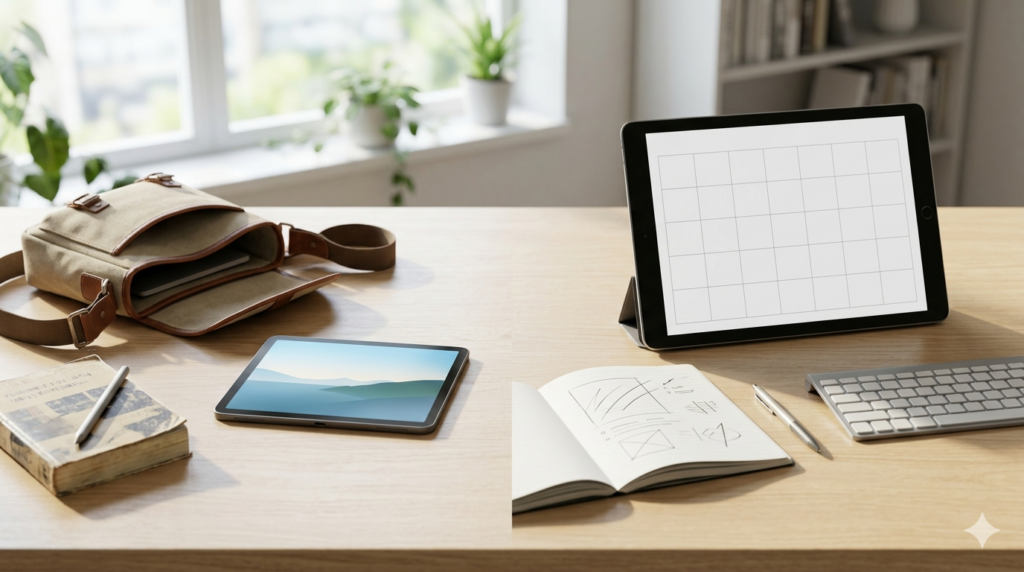
Buyers often compare these two on a product page instead of imagining real places: the train, the couch, the classroom, the desk, the kitchen table, the bag they already carry. The mini tends to gain value when the tablet needs to move constantly with the user. The larger iPad tends to gain value when the device will spend longer stretches open in front of the user.
That practical setting matters more than abstract feature talk. A compact iPad that gets used constantly can be the better purchase even if it gives up screen comfort. A larger iPad that is easier to read, annotate, and live with for longer sessions can be the better purchase even if it is less elegant to carry. Use location often reveals the answer faster than specs do.
Which kind of daily use favors each size
Pick the mini if you want a tablet that behaves more like an always-near companion: easier to carry, easier to grab, and more likely to be used in short but frequent sessions. It especially makes sense for readers, reference-heavy users, and buyers who already know that larger tablets often stay at home.
Pick the larger iPad if you want one tablet to cover general use more comfortably. It is usually the safer fit for first-time buyers, mixed family use, media, PDF reading, and lighter note-taking. If the goal is one easy main iPad rather than a compact specialty choice, the larger form factor is easier to recommend.
Who should stop forcing a size that does not fit
Buyers who want a true all-round main tablet but are fascinated mainly by the mini’s novelty should be careful. The compact size is only a strength if it solves a real carrying problem or a real usage habit. Without that, the mini can feel more restrictive than charming after the first excitement fades.
On the other side, buyers who always imagined a portable reading-and-reference tablet should not force themselves into the larger model just because it looks safer on paper. A bigger screen is not always better if the device becomes less likely to be with you when you actually want it.
The cleanest way to break the tie
Ignore the checkout page for a minute and picture an ordinary week. Which device fits your bag, your desk, your reading habits, your note-taking expectations, and your usual places of use more naturally? That thought experiment usually exposes whether you are buying a better match or just reacting to price and hierarchy.
The best comparison outcome here is not “this one wins.” It is understanding whether your real routine rewards a tablet you carry more often or a tablet you use more comfortably once it is open. That is the fork that matters.
Which size creates less friction once the novelty wears off
The iPad mini and the iPad A16 answer different kinds of satisfaction. One is better when compactness turns into real-world frequency of use. The other is better when comfort, readability, and a broader everyday role matter more than portability. They are not interchangeable versions of the same product idea.
This decision usually has less to do with price than with where the tablet will actually be used. Pick the mini when portability is the point. Pick the larger iPad when general comfort, first-tablet simplicity, and main-device usability matter more.
What to check next